

Farinata, a.k.a. Socca
It's a pancake! It's a flatbread! It's got only four ingredients!

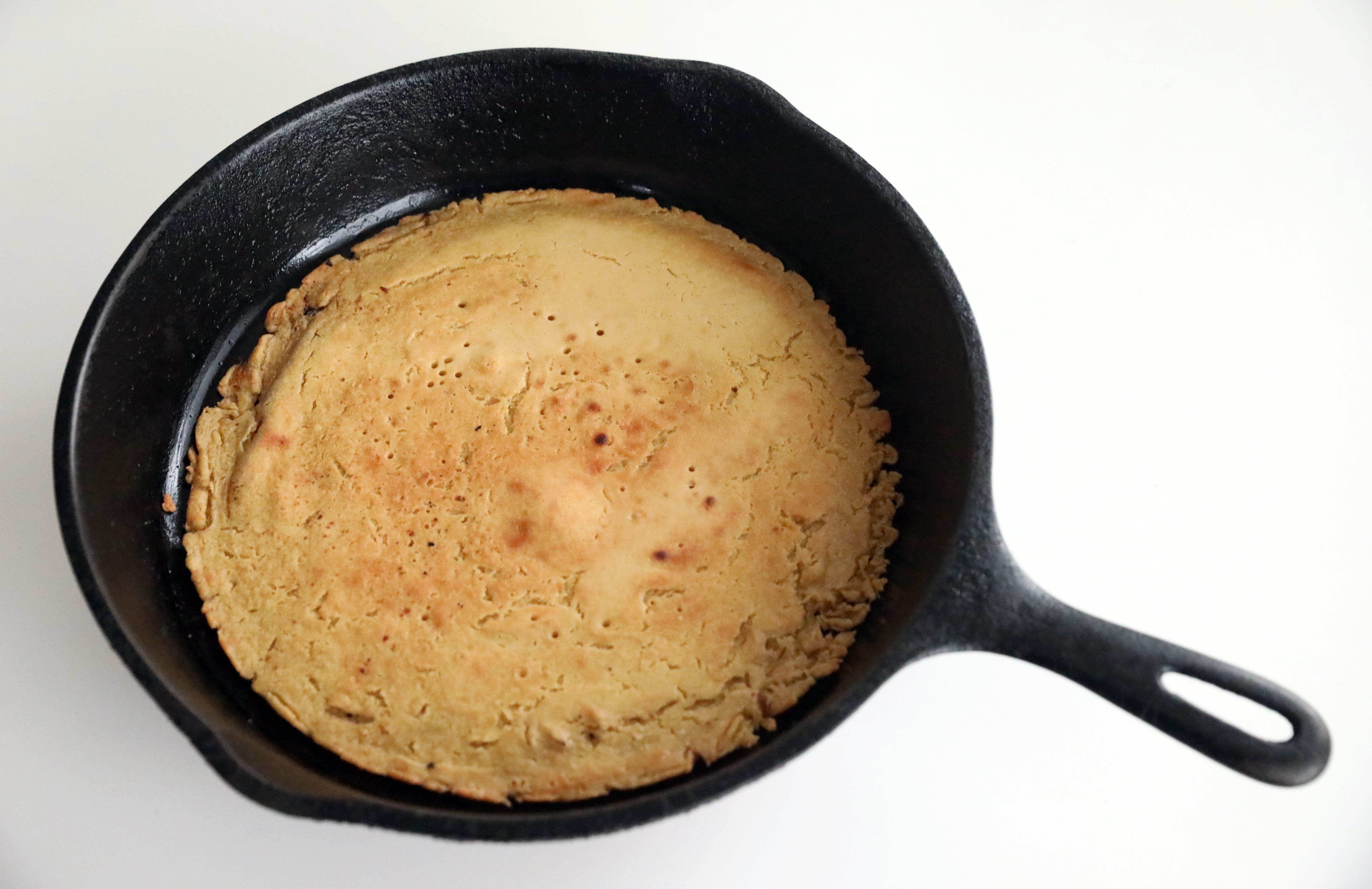
Americans (generalizing broadly) are not particularly hip to the possibilities of legume flours. South Asian cuisines, particularly South India, are for me the undisputed masters, but today I want to look at a Mediterranean delicacy that should be in your repertoire given how easy it is to pull off—and how tasty it is, and how well it takes to just about anything you want to pair it with. Also, in case either characteristic is of interest, this dish represents a perfect example of something that happens to be gluten-free and vegan, but isn’t trying to be something that it’s not.
Depending on where you find yourself on the arc of Tyrrhenian coast stretching roughly from Grosseto in Tuscany to Marseille in France, this dish will be known as farinata, torta di ceci, or socca. It’s the same thing, though many subtle differences exist and additions can vary widely (though they’re generally minimal). Fresh rosemary and/or slivered onions are common toppings, but other herbs or alliums also work—as does nothing at all, which you see in the photo above.
This likely originated as street food, and it still is, particularly in Marseille and parts of Liguria. Because it’s made from chick pea flour, besides being tasty, crispy on the outside and fluffy within, it’s also filling and nutritious—the perfect snack. It’s an ideal blank canvas for whatever else you might have on hand to assemble into a meal, or just stack into a sandwich. I’ve messed around with this a bunch, and have come up with what I think is the easiest formula and method. Whatever you choose to call it, and however you use it, you may find that this becomes an indispensable part of your regular rotation.
